EIFS looks like stucco from ten feet away and behaves nothing like it. Repair it with cement, wash it like masonry or caulk it with the wrong sealant and you will trap water inside a foam wall that has no way to dry. We are one of the few contractors on this coast who treat EIFS as its own system, because that is what it is.
EIFS, or Exterior Insulation and Finish System, is a layered exterior made with foam insulation, fiberglass mesh, a base coat, and an acrylic finish. Unlike traditional stucco, it is flexible and cannot be repaired with cement-based materials. Using the wrong repair method can cause cracking, poor bonding, and further damage. Identifying the system first is essential for choosing the right repair.
Kinetic Stucco Restoration handles EIFS repair, installation, restoration, and inspections across Sarasota, Bradenton, Siesta Key, St. Petersburg, and Riverview. Our masons are trained and certified in EIFS installation, and we use materials compatible with the existing system. Eric personally oversees every project and works with both EIFS and traditional stucco, allowing us to identify the system correctly before recommending any work.
The System Gets Identified First, Not Assumed
We establish what is actually on your building before quoting, which protects you from the single most expensive mistake in this trade, cement applied to a foam wall.
Manufacturer-Compatible Materials
Base coats, meshes, finishes and sealants are matched to the existing system, because mixing incompatible products creates the next failure point exactly where you just paid for a repair.
Certified EIFS Installers
Our masons are trained and certified for EIFS installation, which matters for workmanship and for keeping manufacturer warranty positions intact on newer systems.
We Fix the Water Path, Not Just the Finish
On a system that cannot dry outward, closing the finish over a live leak is worse than leaving it open, so we deal with terminations, flashing and sealant joints as part of the repair.
Honest Advice About Older Systems
If your building carries a pre-1995 barrier system with a moisture history, we will tell you what that realistically means rather than selling you a surface repair that hides it.
We confirm which system you have, its likely age and type, and check terminations, penetrations and sealant joints for where water is getting in.
We determine how far damage actually travels behind the finish, since foam and mesh conceal spread far better than cement does, then scope the work honestly.
Foam, mesh, base coat and finish are rebuilt in sequence with products matched to your system, and terminations are resealed properly before we call it done.
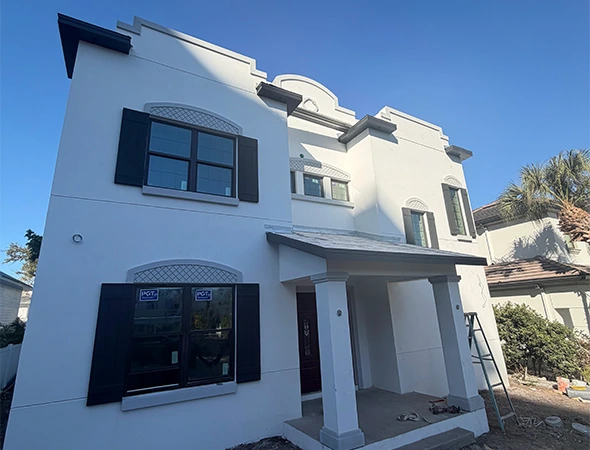
Repairing EIFS correctly means rebuilding the assembly layer by layer rather than filling a hole. Damaged finish is cut back cleanly to sound material with square, non-tapered edges, taking care not to cut the reinforcing mesh beyond the repair area. Wet or damaged foam is removed and replaced with board of matching type and thickness. New mesh is lapped into the existing mesh rather than butted against it, because a joint with no continuous reinforcement across it is a crack waiting to happen. Base coat goes on with the mesh fully embedded, then the finish is applied to match.
Every one of those materials has to be compatible with what is already on the wall, which is why we identify the system before ordering anything. The other half of EIFS repair is the sealant joints, and this is the part most owners never think about. On EIFS the caulking at windows, doors, penetrations and transitions is not trim, it is a working part of the waterproofing, and exterior sealant is a finite-life material that hardens and splits under Florida sun. Harsh solvents cannot be used to clean off old sealant either, since they attack the resins in the finish and can leach through to the foam beneath.
New EIFS installed today is a materially different product from what was going up in the 1980s and 1990s, and the difference is drainage. Modern water-managed systems put a water-resistive barrier on the sheathing and create a drainage plane behind the insulation board, usually through vertically troweled adhesive ribbons or a grooved board, so any water that gets past the outer skin has a path back out rather than sitting against the sheathing. Drainable EIFS became available in the United States around the mid-1990s and was added to the international building codes in 2009.
Installed properly it performs extremely well, and it does something cement stucco cannot: it wraps the building in continuous insulation outside the framing, which removes the thermal bridging at every stud and delivers roughly R-4 to R-5.6 per inch of foam. In a climate where cooling is the dominant load, that is a real operating saving rather than a marketing line. The work that decides whether it lasts is all in the detailing, particularly flashing at openings, board edges wrapped with mesh, proper terminations, and joints designed to be sealed and re-sealed. We install to the system manufacturer’s details, and we would rather lose a bid than install EIFS on a building or a detail where we do not think it belongs.
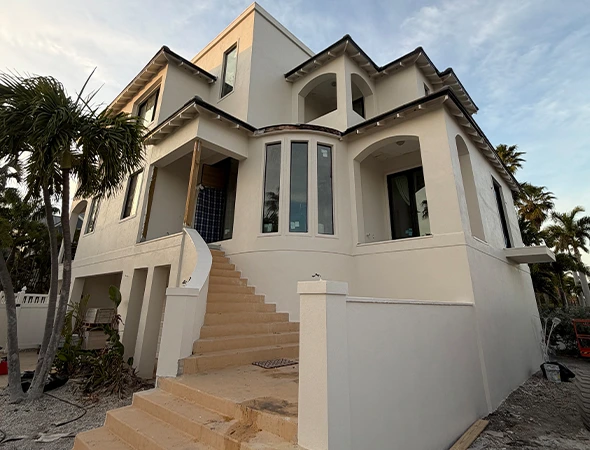
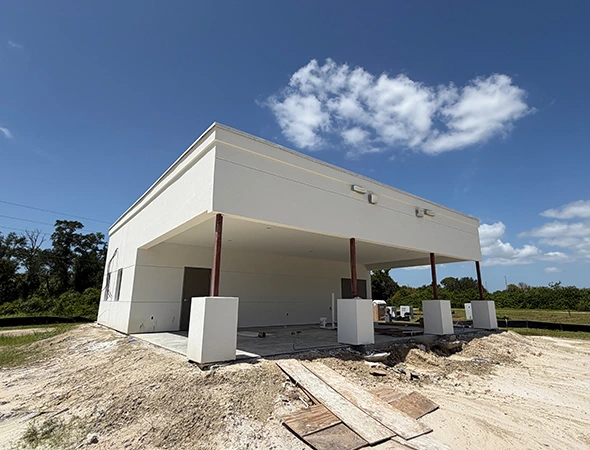
EIFS restoration renews the outer skin across a whole elevation instead of treating individual defects, and on this system it is often the only way to get a result that looks right. The reason is texture matching. Finishes are manufacturer-specific and the acrylic on a twenty year old wall has weathered in ways a fresh batch will not replicate, so an isolated patch that is technically sound can still read as an obvious square from across the street. Refinishing edge to edge, to a corner or a natural break, removes that problem entirely.
Restoration is also the point at which cracking gets addressed properly: fine hairline crazing in an aged finish can be bridged with a high-build elastomeric coating designed for the purpose, which is not the same thing as painting over it with whatever the paint store recommends for stucco. We restore with products from or compatible with the original system. The same edge-to-edge logic applies to cement stucco restoration, though for a different reason there — sun-faded paint rather than weathered acrylic., because a recoat over a wet wall on a system that cannot dry outward makes the situation worse rather than better.
The most important thing to know about your EIFS is which generation it belongs to. Early systems were face-sealed barrier EIFS, relying entirely on the outer skin and its sealant joints to keep water out, with no drainage path behind. When those joints failed, water entered and stayed, and because foam and acrylic hold moisture against the sheathing, the result was rot and mold behind an intact-looking wall. An investigation of more than two thousand homes in Wilmington, North Carolina in 1995 found the problem was not water getting through the system but water being retained inside it, and the litigation that followed reshaped the industry.
Barrier EIFS on wood framing built before the mid-1990s therefore carries materially higher concealed-moisture risk than a modern drainable system, and that is a fact about the era, not about your particular building. It also explains why so much of this work sits on commercial and association-managed buildings, where EIFS went up at scale in exactly those years. It is also why inspection matters more on EIFS than on cement stucco: the same surface conditions can sit above a sound wall or a rotted one, and you cannot tell by looking. We assess system type and likely age, examine terminations, flashing and every sealant joint, and where investigation needs to go further, we test in a way appropriate to the system and seal each test point with EIFS-compatible sealant afterwards.
Should I tear off my EIFS and replace it with traditional stucco?
Usually not, and it is an expensive reflex. If your system is a modern drainable one, or a barrier system with no moisture history and sound joints, the sensible path is proper maintenance rather than removal. Replacement makes sense when investigation finds widespread saturation and substrate damage, since at that point the wall is coming off regardless. The deciding factor is what the inspection finds behind the finish, not the word EIFS itself.
Why does my EIFS need re-caulking when my neighbor's stucco does not?
Because on EIFS the sealant is structural to the waterproofing rather than cosmetic. Cement stucco is thick, absorbent and drains through a weep screed, so it tolerates an imperfect joint. EIFS is a thin skin over foam where the joints at windows, doors and penetrations are the primary defence, and exterior sealant hardens and splits with sun and movement. Most guidance puts resealing somewhere in the five to ten year range. On a Gulf-facing elevation, inspect sooner.
Does having EIFS affect my insurance or my ability to sell?
It can raise questions, particularly on older systems, because of the claims history from the 1990s. Buyers and their inspectors often ask specifically whether the system is barrier or drainable and whether there is documented moisture testing. The practical answer is documentation. A clean inspection record with dated photographs and test results removes most of the objection, and having one before you list is far better than negotiating around a buyer’s report during a contract.
Can EIFS be painted, and does it need to be?
It can, but the coating has to be chosen for the system rather than picked from a general exterior range. Ordinary masonry paint can be too rigid, seal the surface inappropriately, or fail to bond to an aged acrylic finish. Where a wall has fine crazing, a high-build elastomeric made for EIFS gives crack bridging that standard paint will not. Whether it needs doing depends on the finish age and exposure rather than a fixed schedule, which is what an assessment establishes.
Can you match my existing EIFS texture and color?
We get close, and we are straight with you about the limits. EIFS finishes are proprietary, so we work from the original manufacturer’s product where the system can be identified. The harder issue is that acrylic weathers, and a fresh finish beside a twenty year old one will differ even when the product is identical. For small repairs in a textured finish that is often acceptable. Where it is not, the reliable answer is refinishing the full elevation to a natural break so the surface reads as one.
That is the right question to ask before anyone touches your walls, and we will answer it for free. If it turns out you have cement stucco, we will tell you that too. Either way you will know what you own before you spend money on it.
We are a veteran-owned exterior contractor in Sarasota, Florida, with certified EIFS installers and 15+ years on Gulf Coast buildings. EIFS is the part of this trade most contractors get wrong, which is exactly why we invested in getting it right. Call (941) 298-3562.