
Riverview is one of the fastest-growing suburbs in Hillsborough County, and almost all of it went up during Florida’s building booms. That changes the problem. Here the walls are not worn out, they are young, and when a ten year old home is already cracking the cause is usually how it was built rather than how long it has stood.
We work Riverview across the 33569, 33578 and 33579 zip codes, covering the subdivisions along Big Bend Road and Boyette Road, the newer communities out toward Balm Riverview Road, the established pockets nearer the Alafia River, and the growing areas around Gibsonton and Apollo Beach on the way in. Being upfront about distance: our base is in Sarasota, about 45 miles south, which makes Riverview the furthest point we serve.
We book work here in planned visits rather than same-day call-outs, and we group jobs where we can. That works well for this market, because the problems we get called about in Riverview are rarely emergencies. They are homeowners who have noticed cracking on a house that should not be cracking yet, and want to know what it means before deciding what to do.
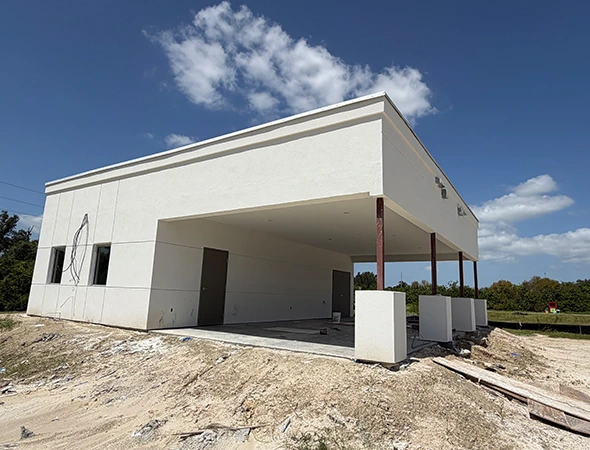
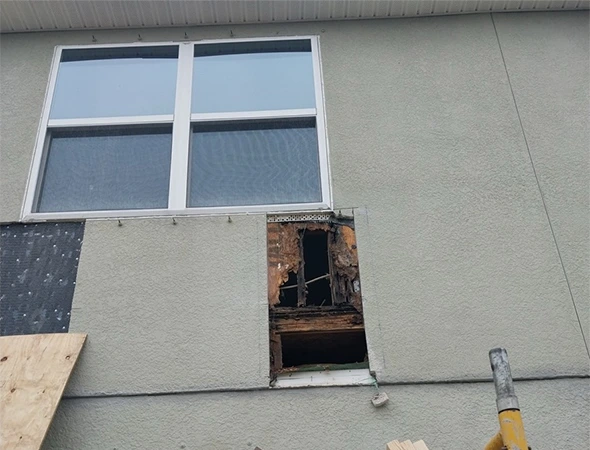
Because of how fast they were built. Riverview’s growth happened in exactly the periods when Florida’s stucco problems were at their worst, and the pattern is well documented. Between 2005 and 2008 homeowners across Tampa Bay reported widespread water intrusion, crumbling walls and mould on relatively new homes, and the issue became large enough to be nicknamed Florida’s billion dollar stucco problem.
The causes were consistent: too few coats, stucco applied thinner than code allows, incorrect fasteners, missing or badly placed control joints, and finish coats applied before the base coats had cured. Florida later updated the building code to clarify curing times between coats, which tells you how common that particular shortcut was. There is also a structural reason quality varied so much. Stucco application is not a separately licensed trade in Florida, so oversight depends on the general contractor supervising their subcontractors. On a subdivision built at speed by one builder, whatever that crew did wrong, they did wrong on every house. That is why stucco repair on a young Riverview wall starts with finding the cause rather than filling the line.
Strikingly new, and that is the whole point of this page. Riverview’s population reached 107,396 at the 2020 census, up from 71,050 in 2010, a jump of more than 50 percent in ten years. The median construction year across Riverview is 2006. Roughly 32 percent of homes here were built between 2000 and 2009, another 30 percent between 2010 and 2019, and more since, so around two-thirds of the housing stock has gone up since 2000. Almost nothing predates 1950.
The median age of residents is in the mid-thirties, far younger than the coastal markets to the south, and the median home value sits well above $400,000. Put those figures together, and the picture is clear: these are young houses owned by people who did not expect exterior problems yet. For reference, Florida’s code requires three-coat stucco over metal lath to be at least 7/8 of an inch thick, and at least 5/8 of an inch over masonry. Measured thickness at a crack edge is often the first thing that tells us whether a wall was built properly. Those are the same thicknesses we work to on stucco installation ourselves.
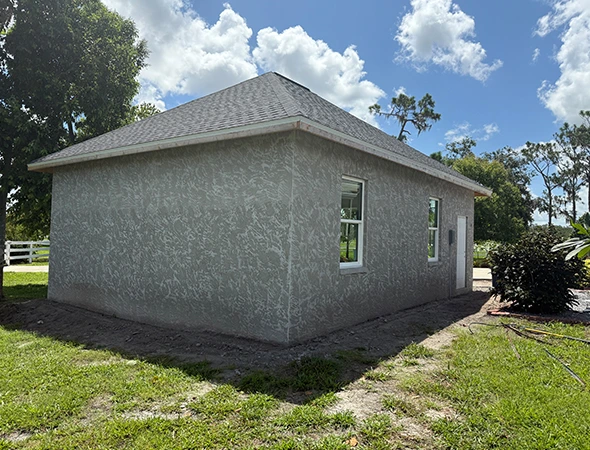
New homes do settle, and some cracking is genuinely expected. The difference is in the pattern, the width and the timing. Use the guide below to work out which conversation you are likely having, then let an inspection confirm it.
| What You Are Seeing | Often Normal on a New Build | Points to a Defect When | What We Check |
|---|---|---|---|
| Fine Hairline Cracks | Yes, in the first year or two as the house settles | They keep widening, spread, or appear years after settling should have stopped | Crack width and whether it has moved |
| Cracks From Window and Door Corners | Short ones are common at stress points | They run well past the corner or track with failed sealant | Joint placement around openings |
| Regular Grid or Pattern Cracking | No, this is not normal settlement | It repeats across an elevation in an even pattern | Lath fixing and control joint spacing |
| Same Cracking on Neighbouring Homes | No | Several houses by the same builder show the same pattern | Whether the fault is workmanship, not your house |
| Staining, Soft Spots or Bubbling | No | Any of it appears on a home under 20 years old | Moisture readings behind the finish |
Several homes on my street have the same cracking. Does that matter?
It matters a great deal. Subdivisions are built by one builder using the same crews and the same methods across every house, so a fault repeats. When neighbours show identical cracking in identical places, that is evidence of workmanship rather than of your particular home settling. It is also worth knowing that documented, comparable cases across a street strengthen any conversation you have with the builder.
How far out do you book Riverview work?
Usually a couple of weeks, sometimes sooner if we already have a job scheduled in the area. At 45 miles Riverview is our furthest market, so we group visits rather than driving up for an hour of labour. Inspections and quotes we can often fit around existing trips. Larger repair and restoration work is scheduled properly with a firm date.
Will my builder's warranty cover defective stucco?
It depends on the warranty length and what the builder accepts as a defect rather than maintenance. Many owners are told that crack sealing is routine homeowner upkeep. That framing is worth challenging when the cracking is excessive for the home’s age. Get the condition documented independently before you raise it, because your own photographs and measurements change the conversation. We provide that record, though we are not attorneys and do not handle the claim itself.
Should I just seal the cracks myself each year?
If you are resealing the same lines annually, something behind the wall is still moving or still wet, and you are treating a symptom indefinitely. Where defect cracking has spread across a whole elevation, stucco restoration costs less than patching each line. Sealant over a defect also hides the evidence you might later need. Have it looked at once properly. If the answer is that the cracks are cosmetic and the wall is dry, then annual sealing is a perfectly reasonable maintenance habit.
My home is around 15 years old. Is it too late to do anything?
Not for the repair itself, which is always worth doing before water gets further in. Whether you still have any claim against the builder is a separate question with strict Florida time limits that run from both the discovery of the problem and the original certificate of occupancy. Those deadlines are shorter than most owners assume, so speak to a construction attorney early rather than after you have paid for repairs.
An inspection will tell you whether you are looking at ordinary settlement or an installation fault, and whether water has already got behind the finish. You will get photographs, measurements and a written assessment either way.